Keeping a creative practice alive when your craft becomes your living
Why part of your creative work should answer to no one
I have memories from childhood of sketching garments, cutting fabric and sitting at the sewing machine with my aunt who was a seamstress. I think I always knew I’d end up in a creative career. I feel fortunate to have made a living off sketching abstract ideas and experimenting with colour, shape, space and type. It often felt like play.
I remember looking up the median salary of a graphic designer and feeling underwhelmed by the estimates. Perhaps it was the naivety of young adulthood that didn’t stop me from pursuing it. Thankfully, at that age, I hadn’t yet been burdened with the inhibitions of older age. It turned out the estimates were way off anyway.
There’s a metaphor I came across later in life, and it comes from the caring professions. It’s a tea cup on a saucer. The cup is so full that the tea spills over into the saucer. The metaphor is offered as an instruction about capacity. What you serve others comes from the overflow in the saucer, not from the cup itself.
I began my design career with an overflowing cup. Design studies exposed me to work that was clever and evocative. It expanded what I thought was possible to create with my head, heart and hands. My world kept expanding and I was hungry to explore all of it. The act of making, even if badly at first, honed my taste and my craft.
Then I began working as a professional designer. While the work was creative, there was something in me that wasn’t being nourished through professional creative work. When I designed, there was always a business outcome attached to it.
In the nine years that I worked as a designer, I barely invested time and energy into projects that were created purely for the joy of it. The real tragedy of that career was that I let the commercialisation of my craft empty a cup I never thought to refill. I consumed a lot of design and I made a lot of design, and I assumed that my cup was being refilled.
It was all creative work, right?
What the work is for
People regularly confuse creativity for commercial purposes with creative self-expression. When I hear a client talk about wanting to move into something more creative, I wonder whether they know which they’re reaching for, and the cost of doing creative work professionally.
Here’s the distinction, as I’ve come to see it.
Creative self-expression starts from within. Something in you wants out. It could be a point of view, a way of seeing, a story, an emotion, an opinion, a critique. The work is in the act of giving it form through art, words, our body, how we present ourselves and what choices we make. Under all of this, is the same desire to embrace what’s actually you. Unconsciously, we spend a lot of our lives absorbing instructions about who to be, what to want, how to look, how to think and live, that being yourself starts to feel like a skill you have to relearn. Creative self-expression is creating for yourself first. Whether anyone pays for it or not, is an afterthought.
Commercial creativity works the other way round. It starts with someone else's need and a creative brief. It could be a message to communicate, a product to sell or an image to build. You use your craft to achieve a certain business outcome. It’s no longer about what you want to express. It’s about what the client wants to manufacture. Design works like this. Form follows function.
I’m separating the two for clarity, but in reality the line between them is blurry. It explains why designers most enjoy briefs that are relatively loose, because that creative freedom is the closest commercial work comes to feeling like self-expression. It works the other way around too. Sometimes a musician writes the song they needed to write and it also happens to be the one that sells. The expression and the market point in the same direction.
The cost of commercialising creativity
The market has its own taste and it exerts a strong influence on creative work. It becomes hard to resist shaping your work and editing yourself toward what the market rewards, rather than what you actually want to make.
Musicians know this as the tension between the record they want to make and the one the record label believes will sell. It’s why we get angry when a musician we love changes their sound and abandons the artistic integrity that initially drew us to them. So we call them a sellout. Every craft has its own version of this.
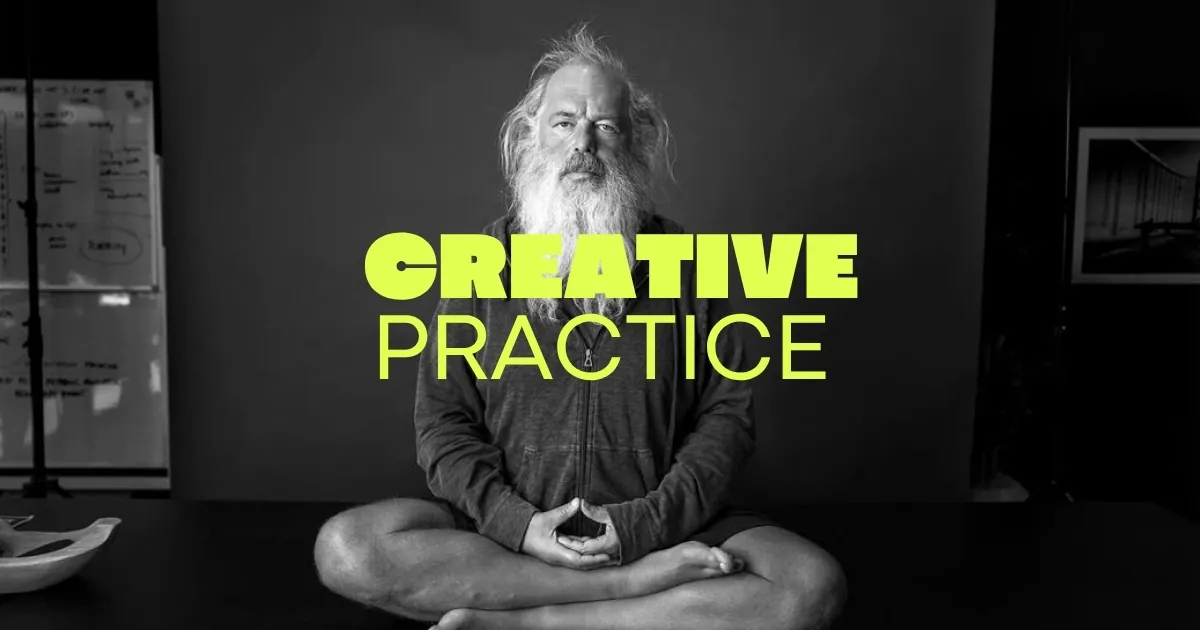
Rick Rubin has produced music for four decades, but it was his book, The Creative Act, that made him a popular figure that everyone quotes these days. I think we’re all a bit obsessed with him because he’s a rare example of creative success and fulfilment.
His philosophy is that creativity is a way of being, and that good ideas arrive through you, rather than from you. The creative process starts to sound like something closer to a spiritual practice. He describes inspiration as something that is received, and it runs through each and every one of us like a current. The work of the creative then becomes about tuning themselves finely enough to notice and give it form. What the market can drain is your access to this creative current.
His advice to anyone serious about their craft is to not ask the art to pay you. When your livelihood depends on the art, the art is forced to answer to something or someone else.
I think he’s right. What he’s protecting is the creative work that exists for self-expression. He goes as far as advising creatives to keep a job that covers expenses and asks little of them, in order to protect the art.
The work that answers to no one
I read this note recently. Between the sellout and the purist, there’s a third path: charge for the work so you never have to stop making it. There’s truth in it, but it also feels unfinished.
Payment for creative work keeps you producing, but it doesn’t protect what the work is for. You can be paid well and make things for years, but still feel your cup emptying, just like I did.
The third path also requires you to protect part of your work from the market. To create for yourself first. There’s more than one way to arrange that. Some creatives keep a creative practice alongside their client work. Some build enough reputation that the client work starts to allow for a freedom that sits closer to self expression.
I’m learning to hold that separation. In my design career, I went looking for self-expression in client briefs, only to realise that the work was choking me more than it was allowing me to breathe.
Over the past year, I’ve felt myself orienting toward self-expression and pulled toward the craft of writing. There’s a trap here that has the same flavour of the mistake I made with my design career. I enjoy writing about self-authorship and meaningful work, but it’s intended for a particular audience and it exists to support my coaching practice. There are other stories that are yearning to climb out of me, but don’t quite belong in this publication.
A business needs to be run as a business with attention given to what reaches people. It will carry elements of my story and my thinking, of course, but the writing that serves the business and the writing I make for myself, feel like they deserve a different relationship from me. I don’t want the first to chip away at the second, the way business outcomes chipped away at my love for design.
I absorbed the belief that if a thing has no productive purpose, it isn't worth doing. But some things are worth being protected from a market that has its own centre of gravity. If, like me, the reason you make things is to express something inside you, then somewhere in your life there has to be a space where that expression answers to no one.
Maybe there’s something you used to create simply because you loved it. Then somewhere along the way, it became work, a service or a product, and now you can’t remember the last time you made it for your own enjoyment. I’d like to hear about how you’ve reclaimed it or protected it.
About Work Worth Doing
Work Worth Doing is a space for people who’ve outgrown a professional career they’ve spent years building, and aren’t sure about what comes next. You’ll find essays on identity, purpose and finding fulfilment outside of work too.
I work 1:1 with people transitioning from a professional career into meaningful work. To learn more about how coaching can support you, book a consultation or learn more below.
First published in Work Worth Doing, my newsletter on the identity shifts, permission barriers and confidence blocks that stand between you and the work you want to do.