Work Worth Doing and the developmental threshold you didn’t know you were crossing.
What career ambivalence is actually asking of you.
Work Worth Doing. The phrase has bite to it. It implies the uncomfortable truth that not all work is worth doing. A sorting mechanism that divides work into worthy and unworthy, meaningful and meaningless. It’s the kind of statement that invites one to pause and consider their career choices to date.
It’s a black and white interpretation, but also not entirely wrong. We’ve all experienced the hollow productivity of reports no one reads, meetings that could have been emails, projects designed to justify headcount rather than solve actual problems. (For more on this line of reasoning, read Moral Ambition).
But Work Worth Doing means something more.
When I quit tech, I told myself the work wasn’t meaningful and what I needed was work with more impact and purpose. These were easy answers. Clean explanations that allowed me to avoid the fear associated with what I actually wanted: complete autonomy and agency over my life and livelihood. I wanted to architect my own path, not execute someone else’s vision. Creative freedom on interesting projects wasn’t going to cut it.
Work Worth Doing is about the inner work that career ambivalence invites us into – confronting the unconscious patterns driving our choices and developing our own set of values and principles. It demands the capacity to trust yourself when there’s no external validation to lean on.
Self-authorship is at the centre of this work. It’s the capacity that makes Work Worth Doing possible.
Why this matters now
We’re living through a strange moment in the history of work. Technology has reshaped work for centuries and each wave of advancement has shifted what humans do for a living. The printing press displaced scribes. The mechanical reaper transformed farming. The sewing machine upended garment production. But each time, new forms of work emerged to absorb the displaced.
Something different is happening now.
We’re hurtling towards what David Shapiro calls a post-labour future, where machines will increasingly handle both physical and cognitive work. Companies are producing more with fewer people. AI and robotics are only accelerating this trend. We’re already living it: mass layoffs in profitable companies, entire departments replaced by software, creative roles absorbed by generative AI.
David Shapiro’s Substack Understanding Post-Labor Economics in Six Easy Steps I’ve been wo
If human labour is becoming less necessary for production, then we are being asked, perhaps for the first time in history, to seriously consider what work is actually for. Not just economically, but existentially.
What would you pursue if economic survival wasn’t the only motivation? What contribution feels worth making? What do you want to spend your finite time doing?
These questions feel impossible to answer when you’re trapped in a job that pays the bills. Yet they’re also becoming harder to ignore.
If you’re questioning what you’re doing with your time, you’re not just having a personal crisis. You’re responding to a shift that’s bigger than you. The question of what makes work worth doing isn’t just philosophical anymore. It’s practical and becoming increasingly urgent.
The old social contract is broken – work hard, stay loyal, climb the ladder, retire comfortably – that story no longer holds. People are waking up mid-career and realising the path they’ve been following was never theirs to begin with. When that realisation hits, most people assume they need a new career.
What they actually need is harder to find.
The presenting problem is rarely the actual problem
Last year, I facilitated 80+ hours of coaching with professionals navigating career ambivalence. Most were in their late twenties to mid-thirties. They’re capable, highly-educated, experienced and all have achieved some form of external success.
What they bring to coaching is rarely a practical problem. It’s emotional.
Predictably, these highly capable individuals believe what they need is a plan. Plans feel like control in an uncertain world. If this were a planning problem, they would have already solved it.
What’s actually stopping them isn’t lack of clarity. It’s permission to want what they really want. Tolerance for uncertainty. The courage to act before everything feels resolved. Self-trust.
They come asking: “Which path to take?” “How do I decide?” “What’s the right move?”. These aren’t planning questions. They’re questions about trusting themselves.
One client came to me after landing what she believed was going to be her dream role. Within a year, she felt deeply dissatisfied. Part of the work was untangling what belonged to the environment she was in (subtle dynamics and unspoken expectations) and what belonged to older patterns she’d learned to carry in similar spaces. The question wasn’t, “Is this job good or bad for me?” It was, “What happens when I stop abandoning myself?”
This is where the real work happens. Not in creating a plan, but in asking the right question. The mistake most people make is trying to solve the surface problem without understanding what is actually driving the dissatisfaction.
When you rush through uncertainty because forward momentum feels safer than sitting still, you risk making decisions that recreate the same pattern in a new environment. Different company, same discomfort. Different role, same abandonment of self.
Work Worth Doing demands something different. It invites you to stay with the discomfort long enough to understand what it’s telling you. To grow in directions you didn’t plan for. To act before you’re ready because you’ve learned to trust your own judgement.
This is the work of self-authorship: learning to trust yourself as the one who chooses.
Self-authorship
Self-authorship is the capacity to generate your own values and principles rather than absorbing them from external sources. This isn’t a skill you learn. It’s a developmental transformation you can’t think your way into.
Most people think that being an adult means acquiring more skills and knowledge – getting better at what you already do. Psychologist Robert Kegan’s research shows something different: becoming an adult is about fundamentally transforming how you understand the world.
Kegan’s theory identifies five distinct stages of adult development. Each stage represents a completely different way of understanding yourself, others and reality itself.
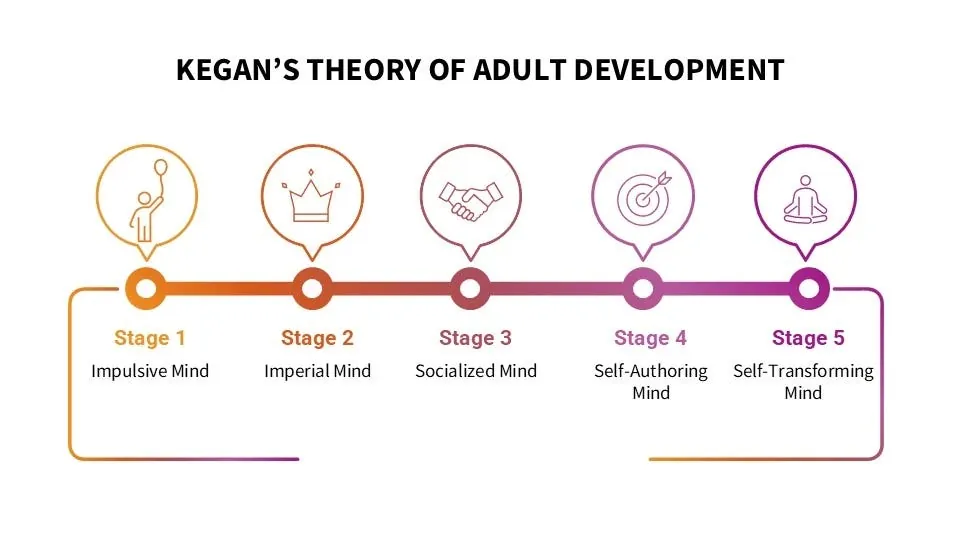
Stage 3: Socialised Mind
About 58% of adults operate at Stage 3. At this stage, our sense of self is shaped by external sources: the ideas and beliefs of the people around us and the systems we’re part of. We derive our values from family, culture, society and institutions.
Our sense of self is borrowed from our relationships, our job title, our company’s brand and what is externally validated. We spend an enormous amount of energy trying to avoid disappointing other people. When there’s conflict between important people in our lives, we struggle to answer: “What do I want?”
This is where most people stop developing.
Stage 4: Self-Authoring Mind
About 35% of adults reach this stage. At this stage, we are no longer defined by other people, our relationships or our environment. We understand that we are a person with thoughts, feelings and beliefs that are independent from the standards and expectations imposed upon us. What was once, “I am my relationships and roles” becomes, “I have relationships and roles, but I choose how I engage with them.”
We determine our own standards for success rather than adopting them from external sources. We can distinguish others’ opinions from our own opinions. We recognise that our interpretation of an event creates our emotional experience. We develop an internal sense of direction and the capacity to create and follow our own path, even when it conflicts with what others expect of us.
The journey between stages
The transition from Stage 3 to Stage 4 is gradual and nonlinear. It typically requires two things: disorientation and time. Something has to shake your existing meaning-making system. A career crisis. A personal tragedy. A relationship breakdown. The realisation that following all the rules didn’t lead where you thought it would. These moments force you to question the external authorities you’ve been using to navigate your life.
This developmental shift doesn’t happen through insight alone. It requires what Kegan calls a subject-object shift: moving what controls us (subject) to something we can control and reflect upon (object). You don’t wake up one morning self-authored. The transition can take years. You build the capacity through repeated acts of self-trust. Small decisions where you choose your own judgement over external approval. It’s practice.
There is no single path to building this capacity. What the paths share is a common feature: they create conditions where you can no longer rely on external structures to tell you who you are or what you're worth.
Some of these conditions are external. A career transition that strips away your professional identity and forces the question: Who am I without it? Building a business tends to surfaces everything you haven’t yet examined: fears around worth, beliefs about capability, inherited stories about who you’re allowed to be and what makes work legitimate. Living across cultures, where the values and norms you grew up with are no longer the default.
Others are internal. Therapy that makes the unconscious patterns driving your choices visible. A contemplative practice (meditation, journaling, time in silence) that creates enough distance between you and your thoughts to examine them. A creative practice that requires you to generate something from your own perspective rather than mimicking someone else's vision. Experiences of grief or loss that dissolve the identity you'd built and ask you to construct a new one.
The outer experiences accelerate the process by removing the scaffolding. The inner practices deepen it by helping you examine what's underneath.
Support structures matter in this liminal space between stages. You need people who can hold complexity with you, who won’t rush you through the discomfort because of their own anxiety. People who won’t hand you their blueprint for how to live.
Professionals trained in developmental work (usually therapists and coaches) understand this distinction. Their role isn’t to provide answers or direction. It’s to help you strengthen your capacity to trust your own judgement, especially when there’s no external validation to lean on. The goal is gradual development of your own internal authority.
Direction that isn’t self-authored doesn’t hold.
What I’m seeing
Most people who come to me aren’t actually looking for a new job. They're responding to something deeper: a growing awareness that the way they've been living no longer fits who they're becoming.
They might call it a career change, reinvention or pivot. What’s really happening is they’re stumbling upon a developmental threshold. They’re being called toward self-authorship.
When you operate at Stage 3, employment feels like the natural answer. Someone else designs the role, sets the standards, tells you what success looks like. You show up, perform well, get validated. The system works…until it doesn’t.
The breakdown happens when you realise you’ve spent years optimising within someone else’s framework. You’ve become excellent at meeting external expectations while slowly losing touch with your own judgement. This is the threshold where most of my clients arrive. The external markers of success are there. The problem is that what they do was authored by someone else.
What happens next follows a pattern. First comes the realisation that the dissatisfaction isn’t about the specific job or company. It’s about operating within constraints you didn’t choose.
Then comes the question: What if I stopped waiting for someone else to design my path?
This question surfaces everything Stage 3 taught them to avoid. What if I fail? What will people think? Who am I to believe I can do this? Buried underneath the fear is curiosity, energy and the first stirrings of agency.
As automation and AI absorb physical, cognitive and creative labour, few of us will be able to rely on our employer to tell us who we are, what we stand for or why our work matters. This is where self-authorship stops being a developmental ideal and becomes a practical necessity.
If your identity is built entirely on your job title and your employer’s brand, what happens when that category of work disappears? If you’re waiting for external structures to tell you what’s valuable and meaningful, what do you do when those structures dissolve?
This is the question career ambivalence is really asking. Not which job to take next, but what work is actually for.
What do you want to spend your finite time creating or contributing to?
That’s not a question you can answer from Stage 3. Your wants are too entangled with others’ expectations to hear your own. Self-authorship is what allows you to know what matters to you and to trust that knowing enough to act on it.
The shift isn’t a change in jobs. It’s a change in how you relate to your own authority.
Where to begin
If you’re standing at this threshold, the most important thing to understand is this: the discomfort you’re feeling isn’t a problem to solve. It’s an invitation to grow.
The people who are most alive are the ones who stopped performing a life that earns approval and started authoring one that feels coherent from the inside.
That shift requires quiet courage, and it’s available to anyone willing to do the work. This is what Work Worth Doing actually means. It’s a commitment to doing the inner work that a meaningful life demands: staying present with discomfort, developing the capacity to author your own path and trusting your own judgement.
That capacity, hard-won and entirely yours, is worth protecting.
Maybe you're convinced the problem is the company, the industry or the timing. I told myself the same thing for years, and it was true enough to be convincing. What's the thing you already know you want but haven't yet given yourself permission to want?
About Work Worth Doing
Work Worth Doing is a space for people who’ve outgrown a professional career they’ve spent years building, and aren’t sure about what comes next. You’ll find essays on identity, purpose and finding fulfilment outside of work too.
I work 1:1 with people transitioning from a professional career into meaningful work. To learn more about how coaching can support you, book a consultation or learn more below.
First published in Work Worth Doing, my newsletter on the identity shifts, permission barriers and confidence blocks that stand between you and the work you want to do.