It’s getting really loud in here. So I started building something you can only experience in person.
A personal reckoning with the noise of modern life and the quietly radical act of gathering people in a room.
This January, there was no fresh-start energy. No surge of motivation that the new year is supposed to deliver on cue.
I had just come back from a three week break during which I read three novels. I let the pace of life slow down to something that felt genuinely sustainable and I relished it.
Then the break ended.
The thought of returning to the treadmill of notifications produced a tiredness that arrived before I’d even opened a single tab. It was the weariness of a person who had just remembered what it feels like to be fully present, and was now being coaxed back into fragmentation.
I suspect you know this feeling. A low-grade dread that hums in the background when the stillness of a break meets the chaos of everything waiting.
Three weeks of immersion in novels had reminded me that sustained attention is still possible, and yet we’ve created a world that actively discourages it. We’ve built infrastructure that monetises interruption and the cost of operating inside it, is becoming very expensive for a person like me.
Neil Postman saw it coming in 1985
In Amusing Ourselves to Death, he argued that the medium through which people receive information fundamentally shapes how they think.
Postman was writing about television. Television’s grammar – fast cuts, emotional imagery, fragmentation, brevity, entertainment value – makes it structurally hostile to serious argument and sustained attention. He warned that the danger is that we will prefer amusement over understanding and lose our appetite for serious thought and complexity.
He couldn’t have imagined that one day, each of us would carry a portable television around in our pocket.
Published in 1985, the book was remarkably prophetic. With the help of social media, algorithmic feeds, infinite scroll and the general collapse of attention, we’ve accelerated the trajectory he diagnosed earlier.
Television’s grammar has infiltrated everything.
Browse any streaming platform and you’ll find thousands of hours of content dressed up as cultural richness, designed to keep you in the room for one more episode, sated, until the night has gone and nothing has been asked of you.
What you will find less of, is the kind of storytelling that leaves you unsettled, demands you sit with a complex idea and refuses to resolve its own tensions into something comfortable by the last episode.
Sustained attention doesn’t vanish overnight. It erodes, and so does agency.
How we got here
This story is much older than television.
Independent journalist, Jonny Harris, recently traced the history of information back centuries. His core argument is that information has always been in a tug of war between the powerful and the masses.
Every time a new medium emerges and briefly democratises the flow of information (the printing press, radio, television, the internet), the powerful move back in. Today, a handful of the world’s wealthiest men are consolidating control over the platforms, studios and the channels through which almost all information travels. The pipes are being bought up. When you own the pipes, you shape the prevailing narrative.
I find myself observing how the world is unfolding around me and the speed at which consequential events are being swallowed by the next big headline. Outrage flares for a news cycle or two, and then it dissolves as the feed moves on to whatever comes next and we forget what’s happened. We move on before we’ve had a chance to digest it all.
The question that I keep coming back to is: If we cannot sustain attention on the things that matter most, what does that mean for our capacity to act on them? That question alone deserves a separate essay to unpack.
Postman called it amusing ourselves to death. What we are doing now might be closer to scrolling ourselves into passivity.
Welcome to the attention economy
Social media arrived with a promise of connection, creative independence, the proliferation of different points of view and democratised reach.
For a while, that promise was real. The idea that anyone could build an audience, reach people they would never otherwise meet and create work that found its own audience was a radical shift in what was possible for an individual.
What followed was the transformation of that promise into an industry. Courses, funnels, engagement strategies and content optimised for reach. Suddenly, everyone was a brand. Everyone had a niche to stake out, a value proposition to articulate and an audience to grow. The crowded marketplace that once existed in the physical world moved online, and the noise it generates is unlike anything that has come before it: billions of people competing for the same finite resource of human attention.
Cory Doctorow has a word for what happens next: enshittification. His argument is that platforms follow a predictable three-stage cycle. First, they begin by offering genuine value: free access, useful services and real connection. Once users are dependent, user data and attention is monetised, ads increase and the experience degrades. Finally, once users are locked in to the platform, value is extracted and transferred upward to executives and shareholders.
You only have to open Instagram Reels to see the end state of that cycle. Everyone is selling something. The feed that once connected you to people you cared about now connects you to people who want you to buy something from them.
Thankfully, social media usage peaked in 2022. By the end of 2024, daily time spent on platforms has dropped nearly 10% in developed countries outside the US. Gen Z is leading the exit, driven by disillusionment, mental health concerns and a recognition that what was once marketed as social has quietly become anti-social.
The attention economy isn’t dying. It’s just increasingly expensive to inhabit, particularly as AI floods every feed with content that is entirely without interiority.
Side bar: I want to be honest about where I sit in all of this. Yes, I will quietly advertise my services at the end of this piece. I am critiquing an ecosystem I am part of, and I think that tension is worth naming rather than hiding.
Writing long-form pieces here on Substack is something I genuinely enjoy. The thinking it requires, the depth it allows, the conversations it opens. What feels like a treadmill is the incessant nudge to stay visible in the small daily ways the platform rewards through Notes. It’s not a reluctance to be seen. It’s a desire to protect a quality of attention and pace that the notification cycle quietly erodes every time I let it back in.
The future belongs to the deeply human
That instinct to protect my attention and resist the pull of the feed in favour of something slower and more deliberate, turns out to be more than a personal preference. It points toward a set of economies that are growing in the shadow of the attention economy. David Shapiro calls them the authenticity axis: a set of economies expanding precisely because AI cannot touch them.
The first is the attention economy, but not as we currently know it. The nature of what earns genuine human attention is shifting. The winners will be those who say something that could only have come from a life actually lived: ideas that have been tested against reality rather than generated by a prompt.
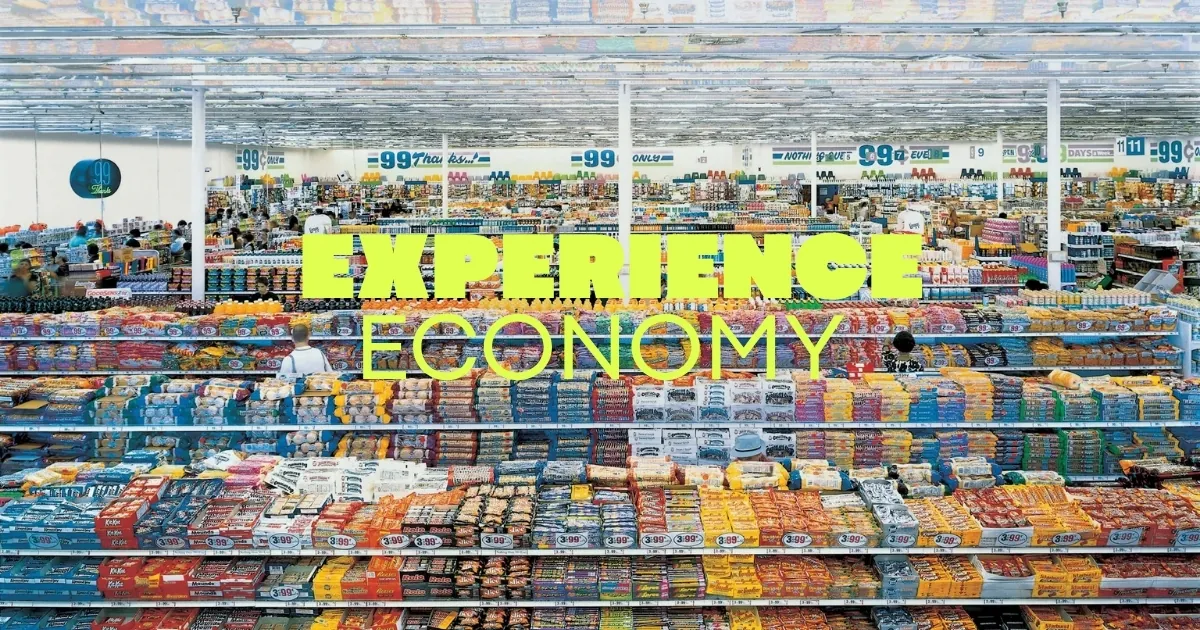
The second is the experience economy. We prefer embodied experiences facilitated by other humans. A live concert is better than a recording because you were in a room with other people, present to the same moment. A dinner where the conversation goes somewhere unexpected and you drive home feeling more alive than when you arrived.
The experiences that cannot be replicated digitally become scarcer and therefore more valuable. We are moving toward a world where people crave physical presence more acutely because they are getting so little of it.
The third is the meaning economy, and it may be the most important of all. As the relationship between labour and income becomes less predictable and AI begins to absorb more of what once defined professional identity, people are asking what matters. That question requires guidance, reflection and the kind of hard-won understanding that only comes from someone who has genuinely grappled with it. This is the economy of therapists, coaches, facilitators, spiritual guides and community builders: roles whose value increases in direct proportion to how much the world around us is automated and accelerated.
Mo Gawdat takes this argument further. He says that the real crisis of AI is not just economic, it’s also existential. Since much of modern identity is constructed around productivity and professional contribution, when that scaffolding is removed, people will face a reckoning. Those best positioned for what is coming are not only the top 1% of technical talent, but those who have cultivated genuine creativity, emotional intelligence, deep relationships and a sense of meaning that does not depend on being productive.
The YouTube thumbnails alone tell you something about the moment we are in.
I’ve written a lot about the attention economy because it’s the water we’re all swimming in.
Understanding its history, mechanics and costs is my way of orientating myself. I don’t believe you can make a considered choice about what you want to create without first understanding the system you’re choosing to work within or against.
The attention economy isn’t where I want to spend my energy, and it’s not where I think the most interesting work is happening. What I do find worthy of my attention is what’s growing in its shadow: the experience economy, and the corner of it I find myself increasingly drawn toward.
If you want to go deeper on the meaning economy and the inner work of decoupling identity from productivity, these earlier essays are the place to start:
I didn’t plan any of this
In the past ten years I’ve moved around a lot. My longest stay in one place was around eighteen months. What I hadn’t built anywhere, was the kind of deep and rooted belonging that sustains a person over a long period of time. I was meeting people everywhere, yet feeling like I belonged nowhere.
In early 2024, I had just moved again. This time to Bilbao. I didn’t know a single person.
It started with a Facebook post. I felt ridiculous even writing it: introducing myself in a women’s group, sharing a photo, and asking if anyone wanted to grab a drink. I wasn’t expecting much.
To my surprise, I was overwhelmed with messages and comments. These messages carried a sense of relief that someone else had made the first bold move. It turned out that many other women were feeling exactly the same as I was. So we met up in person.
Shortly after, I was asked to become a local community leader for Girl Gone International. The group grew to 750 members while I was living there. What strikes me now is the quality of the need it revealed. These women were looking for friendships with people who would come to understand the particular texture of their lives. They wanted to be known by people who were genuinely curious about them.
Since then, I’ve hosted at least one in-person gathering nearly every month since March 2024, from casual drinks to more curated gatherings.
When I moved back to Ericeira in early 2025, something had shifted. I wanted to connect with women who were building something of their own and who understood the highs and lows of growing a business. So I started attending the SheSapiens Women of Impact Breakfasts. What began as me covering for the host while she was overseas, eventually turned into a community leader role.
Earlier this year, I launched Luma Circle with my co-founder Marie. We started gathering women business owners around a dinner table centred on a business topic. What I keep hearing is some version of the same thing: I didn’t know how much I needed this.
Modern culture has made commitment feel like a risk. Nobody wants to commit to plans anymore. The RSVP has become a negotiation: maybe means “probably not”, yes means “I'll decide closer to the time” and no means “I'd rather keep my options open”. It’s a response to modern life: everyone is overstimulated, tired and managing invisible workloads. So we all hover at the edge of connection, hoping that connection will arrive fully formed, without effort.
What I’ve discovered in the short time I’ve been doing this work is that going first (making the first move, extending the first invitation) is a rare and valuable skill. Community has rules, and one of them is that someone has to go first.
Curation and facilitation
I spent most of my career in experience design. It’s the umbrella term for visual, interface, user experience, product and spatial design. Experience design is about intentionally shaping an experience, whether digital, physical or augmented. I got into it because I loved beautiful things. Not just aesthetic things, but things that make you feel something deeply human or provoke reflection.
The questions I liked asking were:
What does this experience open up for a person? Where is the friction? Where is the delight? What does the experience of moving through this space actually produce in a person?
I’d been asking those questions about human-computer interactions for a decade. Now, I ask them about human-human interactions, group dynamics and rituals.
I don’t have a settled name for this work yet. The term community builder has become so common that it’s started to lose its meaning, and the word community has been so thoroughly colonised by tech platforms and corporate wellness programmes that it no longer reliably points toward what I’m trying to describe.
What I do sits closer to curation and facilitation: creating conditions for genuine human connection.
You can rent a beautiful venue, invite interesting people and still end up with an evening that feels transactional and hollow. I’ve been in those rooms. I’ve also been in rooms where something different happens, where the conversation goes somewhere nobody planned and people leave less alone than when they arrived. The difference between those two rooms is almost always the person holding the space and how willing they are to go first.
What I’ve learned is that the host sets the tone for everything that follows. When a host shares something real at the start, something with a little vulnerability in it, the room reads that as permission. People stop performing and start connecting.
Empathy, facilitation, the courage to be the first person in the room to say something true, a sensitivity to what a space needs at any given moment: these are developed through practice and through the kind of inner work that makes authenticity possible in the first place. There is a real and growing gap for people who can do this well, and I think it’s one of the most undervalued forms of work in the experience economy.
I don’t have a five-part framework to offer you. That may come in time. What I have right now is a growing body of lived experience and a clearer sense with every gathering of what works and what doesn’t.
Where the outer work meets the inner work
The work I do in coaching has always been about the inner journey: helping people decouple who they are from the professional identity they’ve built, reconnect with what they actually value and create something that genuinely feels aligned. That work happens in the slow and careful space of a coaching relationship.
What I’m noticing in the gatherings I host is that the same territory comes up. When you put a room full of women who are building businesses together and hold the space well enough that people feel safe to be honest, what surfaces is rarely a question about strategy or growth. It’s almost always something more personal. The fear of being seen. The guilt of charging what you’re worth. The loneliness of making decisions that nobody else fully understands.
Building a business is one of the most reliable vehicles for personal development I’ve encountered. It has a way of surfacing everything you have been avoiding. Every fear, every inherited belief about worth and visibility and what you are allowed to want, eventually finds its way to the surface.
What I’m moving toward is a space where the outer work and the inner work are not treated as separate tracks and where the practical questions of building a business sit alongside the deeper questions of who you are becoming in the process. I don’t know exactly what that looks like yet. I’m learning as I go, which is exactly what I’d tell my clients to do.
It’s only going to get louder
The next decade will be louder than anything we’ve experienced so far. More content, more noise, more AI-generated everything, more people competing for the same finite resource of human attention. More personal brands, more people selling something.
There will be questions worth reckoning with: What kind of work do you want to do? What kind of life do you want to build? What you are willing to protect? What you are willing to let go of?
Let me be clear. This essay is not a blueprint. It’s not a call to action to quit your job, start a business or become a community facilitator. This essay is closer to a series of deliberate choices made by someone who got tired of the noise and started asking what she actually wanted to move toward instead.
Something that gets lost in the conversation about the future of work is that culture is not something that happens to us. It’s shaped, incrementally and quietly, by what individuals choose to create. Every person who decides to gather people in a room rather than perform at them online is making a small cultural choice. Every writer who chooses depth over discoverability. These choices compound.
If the attention economy extracts, the experience economy gathers. If content is infinite, presence becomes rare. If production is automated, meaning becomes the differentiator.
The future, at least the part I want to help create, is deeply human.
I wrote this essay because I needed to make sense of my own resistance, and because I suspected I was not the only one feeling it. Are you someone who is quietly retreating from the noise and building something more human in its place? Tell me in the comments below.
About Work Worth Doing
Work Worth Doing is a space for people who’ve outgrown a professional career they’ve spent years building, and aren’t sure about what comes next. You’ll find essays on identity, purpose and finding fulfilment outside of work too.
I work 1:1 with people transitioning from a professional career into meaningful work. To learn more about how coaching can support you, book a consultation or learn more below.
First published in Work Worth Doing, my newsletter on the identity shifts, permission barriers and confidence blocks that stand between you and the work you want to do.