Job, career and calling explained. Why the same work leaves one person satisfied and another unravelling.
Your dissatisfaction is likely a mismatch between what you want work to hold and what that job was built to hold.
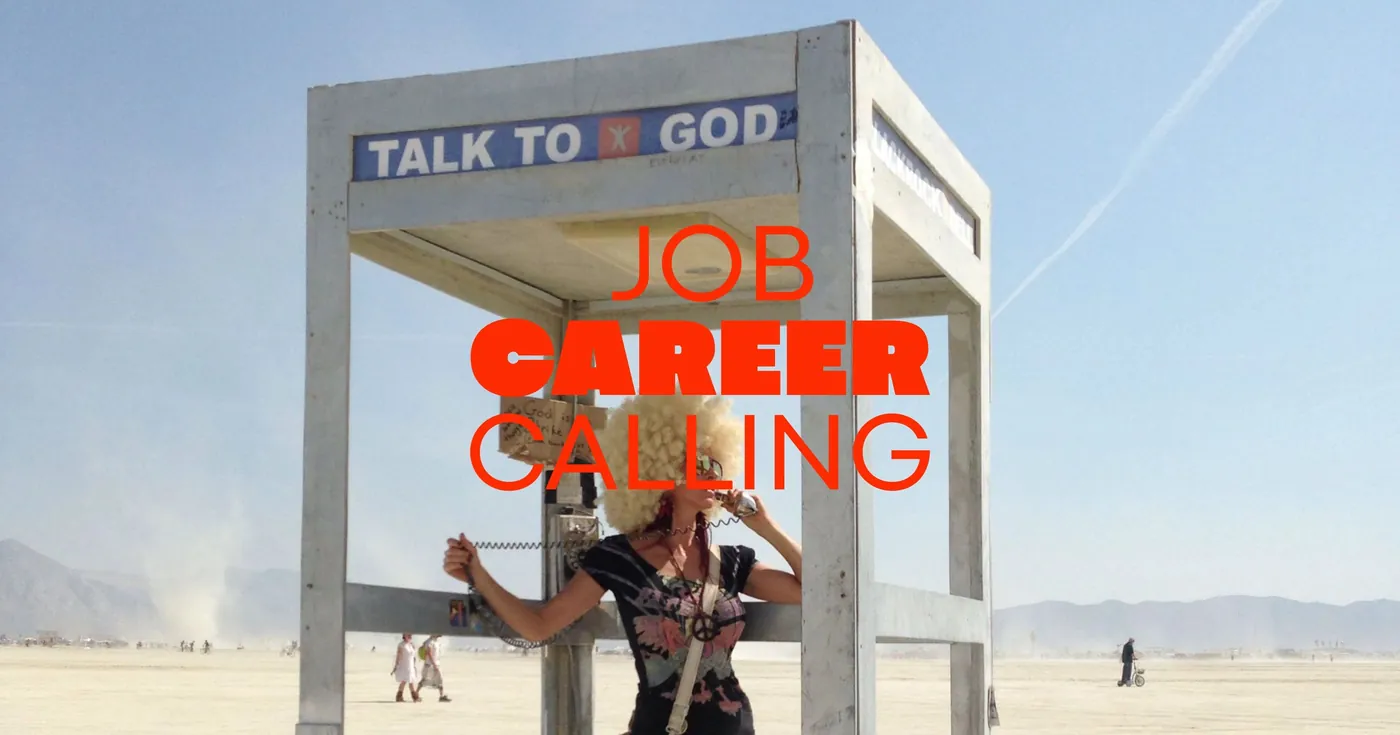
What interests me about the note above is what this reflection is asking for. Both sides make a compelling case, and both are presented as though there’s only one objectively correct answer. It’s a reasonable thing to want, because an answer would tell you what to do and how to feel about your work.
There’s vocabulary for this
There are three words that we tend to use interchangeably, but actually describe three different relationships to work:
Work as a job
Work as a career
Work as a calling
The terms comes from Habits of the Heart, by the sociologist Robert Bellah and four other colleagues. They interviewed around 200 white middle-class Americans about freedom, success, justice and what made a life good. The book that came out of it is really an argument about how American individualism over-emphasises personal freedom at the cost of social responsibility, leaving individuals to improvise meaning alone.
Work shows up as one of the places where meaning is improvised. The authors write about three distinct patterns they observed in how people talked about what they did for a living.
Twelve years later, Amy Wrzesniewski and her colleagues set out to test whether these three patterns held up. They wrote a short paragraph describing each one and gave them to 196 employees across a wide range of occupations, from administrative staff to licensed professionals. They asked them to rate how much each of the descriptions sounded like them. What they found was that people sorted themselves almost equally across the three descriptions.
Then they did something even more interesting.
They isolated a subset of 24 administrative assistants, all doing the same kind of work with the same title and similar duties. If the orientation was determined by the type of work, this group of people should have naturally clustered into one category.
But they didn’t.
Instead, they distributed themselves equally across all three descriptions. This tells us that isn’t the type of work that determines the orientation. It’s your relationship to work.
How two people experience work so differently
A friend wrote an emotionally raw piece describing in detail, how she feels being caught in the corporate trap. At one point, she contrasts her experience of work with her partner’s, whom she describes as a master of not-giving-a-fuck.
His approach?
Indifference. Take nothing personally, stop involving yourself and don’t bother going above and beyond. Then she arrives at her own conclusion. Indifference just doesn’t work for her. It’s a path she’s been down and it isn’t one she wants to revisit.
When the people around you aren’t bothered by the job, it tends to compound your own confusion about why the job seems to be enough for everyone else but it isn’t enough for you.
I think these three distinctions partly explain how two people might approach similar work so differently. I wonder whether some career dissatisfaction is caused by asking your current work for something it was never going to give you.
It’s a mirror, not a map
I find these categories helpful, but they’re a mirror, not a map. They help you identify where you stand, but it doesn’t tell you where to go next.
When I worked as a product designer, I would have ranked the career description first and the calling description second. Work was the vehicle to a higher income, a better title, more status and much of my sense of self was tied to the outcomes of that progress.
These days, I think the order has swapped. Calling first, career second.
I haven’t renounced ambition. I still care about progress, achievement and financial security. All of that remains intact, but I don’t believe that career success always leads to deep fulfilment, and that’s what I care about most these days.
Do I consider my work a calling? Yes and no.
Part of my hesitation is about the word itself, which carries its religious inheritance with it. To have a calling implies that something outside of you is doing the calling. For me, there was no holy revelation. It didn’t arrive out of thin air or from a God I was connected to. The word we use now is vocation, from the Latin vocare, meaning to call or summon, which still preserves the same religious thread.
Lately, I’ve been asking myself why I do the work I do. I believe in contributing to something greater than my own personal advancement and aligning what I do with what I value. Initially, the motivation was my own personal development, and partly because I was running away from a career I no longer wanted.
I talked about it at length with a friend in the same field. I told her that what I love about my work are the micro-moments of bearing witness to another person’s vulnerability. Watching someone touch something tender and precious, and being allowed to stay. It’s the bravest thing I’ve seen and it’s inspiring for someone who has always struggled with vulnerability herself.
The cost of a calling
It would be easy to read these three categories as a ranking, with calling at the top and job at the bottom. The research is careful to say that there is no hierarchy and no correct orientation.
However, the people with a calling orientation are said to have higher levels of satisfaction with their work and their lives. This might sound like an argument for finding your calling, but a calling can be a double-edged sword.
Much of the research since this study has focussed on the costs of a calling. It can make people easier to underpay and slower to leave poor working conditions, because the work feels like a duty rather than a transaction. Someone who would do the work regardless of pay puts themselves in a poor position to negotiate. It can also make someone more willing to disregard discouraging advice from a mentor they trust.
Someone with a calling orientation has the most to gain, but is also the most exposed.
Corporate structures are built for a career orientation
Companies don’t exist to help you fulfil your purpose. They exist to make profit.
One thing I loved about working in a company was the clear pathway for moving up. It delivered a real sense of certainty. There was a clear hierarchy of roles, with a defined rubric for what you had to demonstrate to reach the next level, a mentorship structure to support your development, promotion cycles, performance reviews and salary bands. All of it built to feed the desires of someone with a career orientation.
Every part of the design assumes you’re optimising for personal advancement. So what happens when you’re still in the corporate role and your orientation starts shifting?
Nothing. The ladder, the rubric, the promotions are still there. This well-designed system goes on measuring exactly what it was built to measure, and nothing in it registers that you’ve started wanting something else. What people often carry across in the space between a career and calling is the old career scoreboard.
The useful thing about status, progression and achievement is that you always know where you stand. You can compare this year’s figure against last year’s figure and determine whether you’re making progress. People leave a career for work that means something to them and immediately measure it against what the old job paid and the status it gave them.
It produces a particular kind of misery. You could be doing good work, but feel like you’re failing because you’re marking it against the wrong rubric.
As far as I know, nobody has created a rubric for a calling.
There’s a trap here
It’s the assumption that a calling needs to earn you a living.
Sometimes a calling and a desire for financial security genuinely compete. Nobody goes into fine art because it guarantees the mortgage gets paid. Some callings can hold the pressure of having to earn, some need time to exist before the market exerts its own pressure on them, and some are meant to exist away from the market altogether.
If you've ever seen the Ikigai diagram, you've seen this assumption in action.
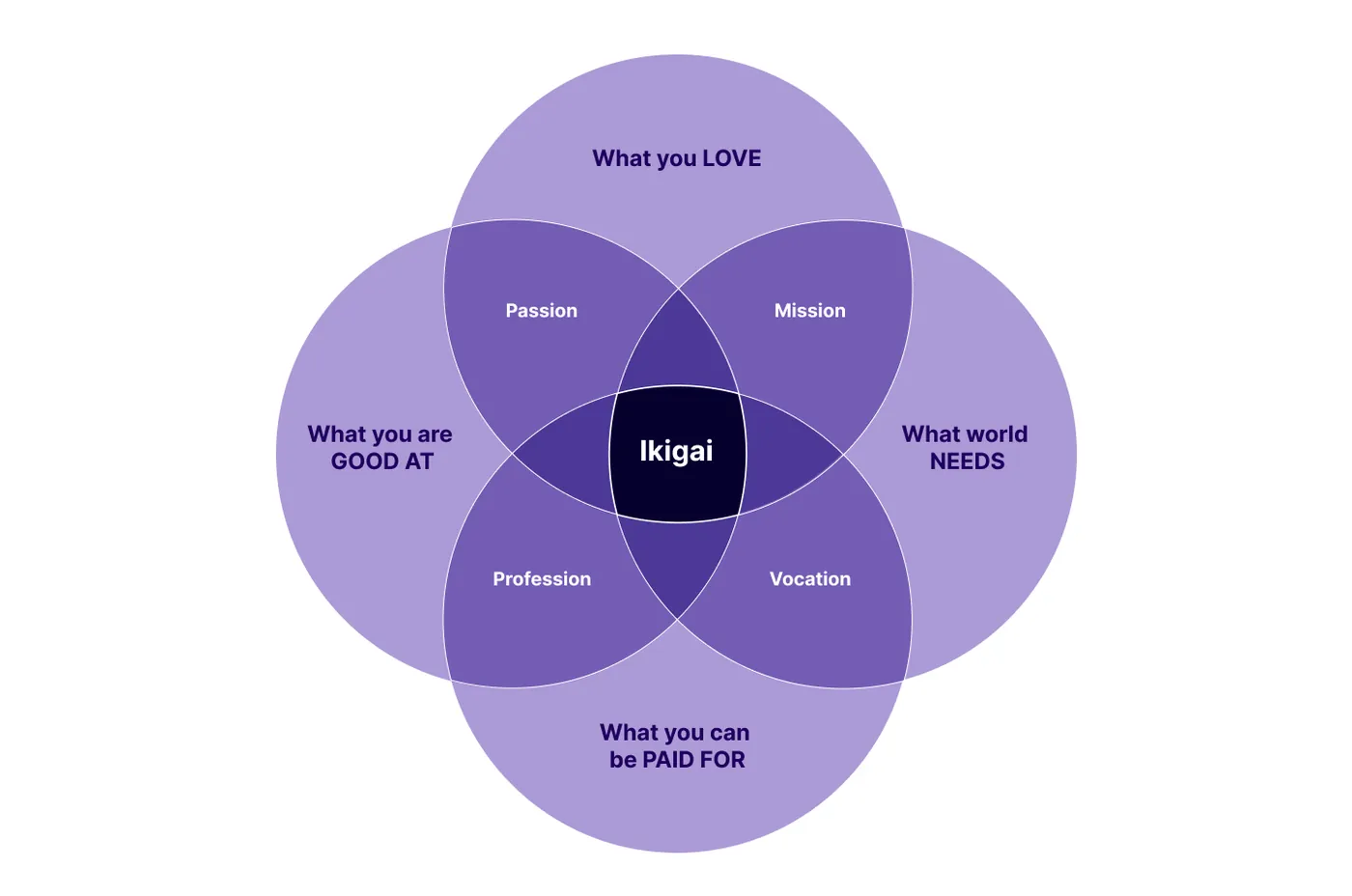
This Venn diagram is not Japanese. It was originally created as a framework for purpose by a Spanish astrologer. The framework was then retitled by a British business coach who published it on his blog. Since then, it’s spread like wildfire and perpetuated a misunderstanding of what the Japanese concept of Ikigai actually represents.
Other than the gross misrepresentation, what grates on me about this diagram is that it suggests that purpose comes from work that you can paid for.
The Japanese concept of Ikigai is actually about the significance of daily actions in shaping your sense of fulfilment. It’s found in small, ordinary moments, like gardening, drinking a cup of coffee, or spending time with family. In other words, fulfilment isn’t only found in grand gestures (like your career achievements) but in simple and profound moments that make life meaningful.
The altar moved into the office
Writing this essay has raised more questions than it’s answered. I began writing it three weeks ago and then I left it alone because I went down several rabbits holes and emerged with a lot more than one essay can hold. If you’re down for a trip into the depths of work, religion, identity and our search for meaning, I have much more to say about these topics. So, read this as working thesis, rather than gospel.
Everybody worships something. If it’s not religion, then it’s work, money, power, beauty, intellect, people, ideologies...
For most of history, the question of what your life was for had an answer that arrived from outside you. It came from a God, from your tribe, or from your lineage. In some ways, it was easier, because nobody was left alone to work out what their life was for.
As religion has fallen out of favour with an increasingly secular society, we’ve gone looking for what it used to supply. Work is where many of us now expect to find purpose, belonging, identity and a reason to get up in the morning.
That’s an enormous amount to ask of something that also has to pay your rent.
Which of the three did you start with, and which one are you in now?
About Work Worth Doing
Work Worth Doing is a space for people who’ve outgrown a professional career they’ve spent years building, and aren’t sure about what comes next. You’ll find essays on identity, purpose and finding fulfilment outside of work too.
I work 1:1 with people transitioning from a professional career into meaningful work. To learn more about how coaching can support you, book a consultation or learn more below.
First published in Work Worth Doing, my newsletter on the identity shifts, permission barriers and confidence blocks that stand between you and the work you want to do.